

Reciprocal IVF (ROPA) is one of the fastest-growing treatment approaches in modern reproductive medicine. More and more female same-sex couples want to share parenthood not only emotionally but also biologically. For fertility clinics, this creates new workflow requirements: treatment pathways that accurately manage two patients within one partnership, donor material, and the seamless traceability of gametes and embryos.
Not all IVF software is designed for this level of complexity. Clinics documenting Reciprocal IVF cases need a system that treats same-sex partnerships as an integral part of the workflow rather than as an exception.
What is Reciprocal IVF?
Reciprocal IVF (rIVF), also widely known in Europe as the ROPA method (Reception of Oocytes from Partner), is a form of in vitro fertilization in which both partners actively participate in achieving the pregnancy. One partner undergoes ovarian stimulation and provides the oocytes, which are fertilized with donor sperm during an IVF cycle. After appropriate preparation, one or more resulting embryos are transferred to the uterus of the other partner, who carries the pregnancy and gives birth.
The result is shared parenthood in the most literal sense. As reproductive medicine specialist Sonia Gayete-Lafuente from the Center for Human Reproduction explains, one partner establishes a genetic relationship with the child by providing the oocytes, while the other develops a gestational relationship by carrying the pregnancy. From a medical perspective, the answer to the frequently asked question of who the mother is remains straightforward: both. Genetics, pregnancy, childbirth, and everyday caregiving are all part of the same parenthood.
Why Medical Assessment Is Necessary Even Without a Known Fertility Disorder
A common misconception is that Reciprocal IVF will automatically succeed if neither partner has a diagnosed fertility disorder. In reality, there is no simple test that reliably determines a woman's fertility, apart from a history of unsuccessful attempts to conceive—a history that same-sex female couples typically do not have.
For this reason, it is essential to assess both partners before treatment begins: one for her suitability as the oocyte provider and the other for her ability to achieve successful implantation and carry a pregnancy. If any medical concerns are identified, treatment protocols can be adapted accordingly.
Regulatory requirements surrounding donor material add another layer of complexity. Because Reciprocal IVF involves donor sperm and the transfer of oocytes from one partner to the other, clinics must comply with strict regulations regarding infectious disease screening and, depending on the origin of the donor sperm, defined quarantine requirements.
These regulatory frameworks differ between countries. In Germany, for example, the Sperm Donor Register Act, which entered into force in 2018, provides a clear legal framework and places particular emphasis on documentation and reporting obligations. Clinics in other jurisdictions must comply with their respective national regulations governing donor material and assisted reproduction.
Legal Parenthood
While the medical definition of parenthood is clear, the legal situation is far less consistent. A genetic relationship and a gestational relationship do not automatically correspond to legal parenthood. Depending on the country and the couple's marital status, the partner who gives birth is often recognized as the legal parent at birth, whereas the partner who provided the oocytes may be required to complete additional legal procedures, such as parental recognition, formal consent, or second-parent adoption.
Because these legal requirements differ considerably between jurisdictions, obtaining legal advice before treatment is strongly recommended. For fertility clinics, this primarily means that consent forms, patient documentation, and treatment records must be accurately recorded, version-controlled, and fully traceable.
Role Reversal and the Use of the Same Donor
Many couples choose to undergo two Reciprocal IVF cycles, switching roles between treatments. This allows each partner to provide oocytes once and carry a pregnancy once. Frequently, the same sperm donor is used for both cycles, enabling the resulting children to share the same biological father and become genetic half-siblings.
For fertility clinics, this creates important documentation requirements. Donor material may need to be reserved over several years, treatment records must remain linked across multiple cycles, and the origin of every gamete and embryo must remain fully traceable. This is where the capabilities of an IVF management system become critical.
How MedITEX Supports Same-Sex Couples
MedITEX IVF does not treat same-sex partnerships as a workaround but as a dedicated system feature. Since version 2.6.1, two women can be linked as partners within the Demographics → Partnership section. Both patients are managed as part of a single treatment relationship while maintaining completely separate medical records, histories, and clinical findings.
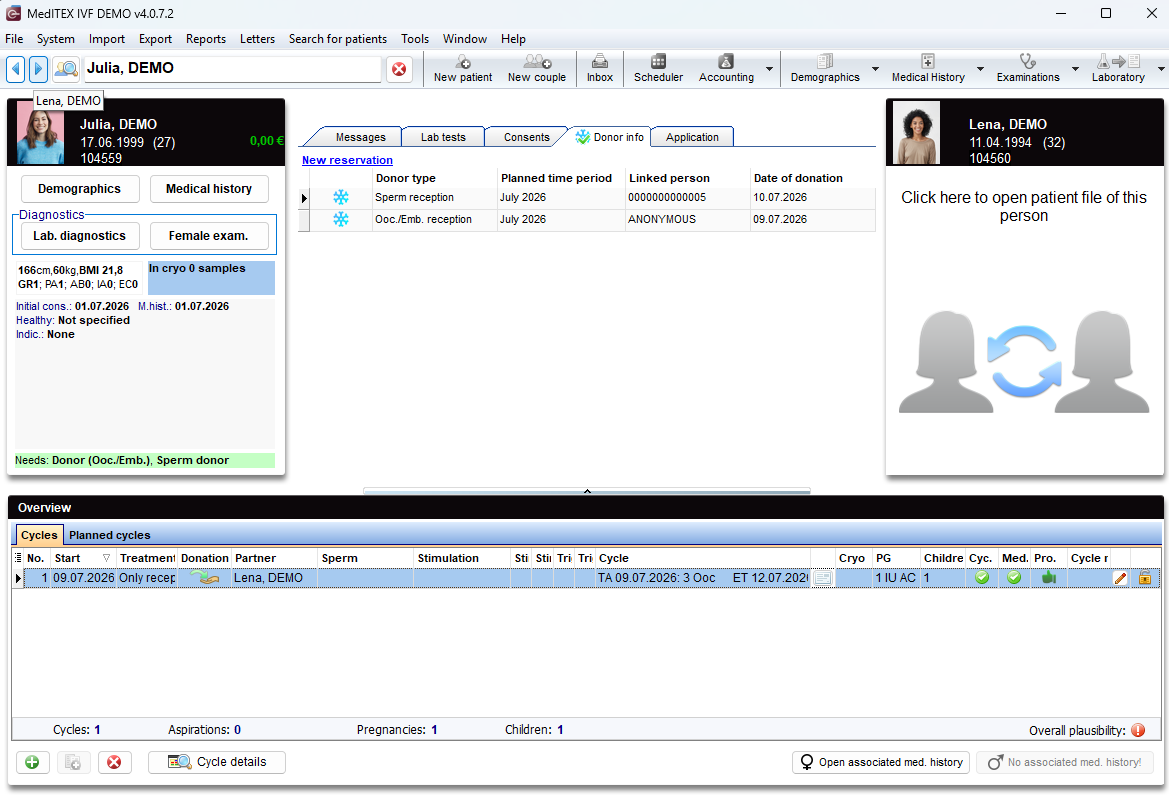
This provides the foundation for a properly structured Reciprocal IVF workflow: one partner is assigned as the oocyte provider, the other as the gestational patient, while both remain permanently and correctly linked throughout treatment.

The importance of clear patient assignment in Reciprocal IVF is further demonstrated by an enhancement introduced in version 4.0.5. When a fertilized cell is thawed that originates from a different partner, the thawing process must be actively confirmed before proceeding. This scenario—where an oocyte or embryo from one partner is used during the treatment of the other—is the defining characteristic of Reciprocal IVF. The mandatory confirmation acts as an additional safeguard against mix-ups and strengthens electronic witnessing procedures within the laboratory.

Version 4.0.5 also introduced an additional verification step before deleting a patient who is linked within a same-sex partnership. While this may appear to be a minor technical detail, it is essential for maintaining data integrity across interconnected patient records. It also demonstrates that support for same-sex couples is continuously maintained within MedITEX rather than implemented as a one-time feature.
Beyond partnership management itself, MedITEX's established functionality directly supports Reciprocal IVF workflows. This includes donor material management with reservation functions, country-specific release rules and quarantine monitoring, cryostorage management with complete traceability of straws and samples, customizable informed consent forms with configurable validity periods, and integration with national IVF registries, including the German IVF Register. For treatment pathways involving two patients, donor sperm, and potentially multiple treatment cycles, this level of end-to-end traceability is not a convenience—it is a necessity.
Conclusion
Reciprocal IVF is more than another assisted reproduction technique. It reflects the evolving understanding of parenthood and represents a rapidly growing area of reproductive medicine. Fertility clinics supporting same-sex female couples require an IVF management system that structurally accommodates these partnerships, securely manages gamete and embryo traceability across two patients, and supports the regulatory requirements associated with donor material.
MedITEX IVF provides these capabilities today and continues to expand them as clinical practice evolves. This allows fertility clinics to focus on what matters most: helping two women achieve their shared goal of becoming parents.
Sources
Gayete-Lafuente, S. (2026, July 13). What is reciprocal IVF? The Reproductive Times. Center for Human Reproduction. https://www.reproductivetimes.com/p/what-is-reciprocal-ivf
Marina, S., et al. (2022). Why are the proportions of in vitro fertilisation interventions for same-sex female couples increasing? Journal of Clinical Medicine, 11(2), Article 345. https://www.ncbi.nlm.nih.gov/pmc/articles/PMC8702152/
MedITEX IVF. (n.d.). Release notes. https://www.ivf.software/release-notes
MedITEX IVF. (n.d.). Release notes version 2.6.1. https://wiki.meditex-software.com/images/ReleaseNotes2.0.pdf
MedITEX IVF. (n.d.). Release notes version 4.0.5. https://www.ivf.software/meditex-release-notes/meditex-version-4-0-5-de


